



{:en}How to allocate budget for Digital Marketing?{:}{:es}¿Que presupuesto asignar al Marketing Digital?{:}
{:en}
How much you should spend in Digital Marketing and how to allocate the right budget we need to implement our Digital Marketing strategy become recurring questions among those who are just starting the Digital Marketing career, those who are looking for information to peek into this world, and even for those who have already traveled some distance and they still doubt the effectiveness of this investment. There are certainly many variables that must be considered to calculate the cost or budget of this type of Marketing.
As a first guideline to define this budget, it must be taken into account at what moment or in what position your company is in relation to your objectives and what efforts you need to make to achieve them.
In other words, your marketing efforts will be determined first and foremost by your marketing goals and environments, and the latter will determine your budget.
Now, the digital marketing ecosystem of a company is defined by its sector or industry, and they are categorized according to their size, among other aspects.
That said, we can deduce that the Digital Marketing budget of one company differs from another, as much as the household budget for each family on the planet.
It is easy to understand, then, that the Digital Marketing budgets of two fast food restaurants will never be the same and much less similar to that of an aviation company, a church or a barbershop.
However, despite the complexity involved in answering such a challenging question, in this post we will try to help unravel the interweaving of the Digital Marketing budget to offer you a general structure that serves as an initial guide regardless of when you are. your venture or company.

What factors should be taken into account when planning a Digital Marketing budget?
The Digital Marketing budget is based on a set of online strategies aligned with the objectives. The scope of these strategies presupposes the definition of the means and resources to be used to provide the best user experience, while we achieve the most suitable infrastructure to make our digital ecosystem more efficient. But, all of this depends on the following differentiating factors:
- Business model
- Marketing objectives
- Industry or sector
- Business Environment
Business model:
There are different business models, comprised of three large groups; traditional, virtual and hybrid business models, among which we can indistinctly find the following:
- Direct Sales of Products and services
- Franchises
- eCommerce
- Dropshipping
- Affiliate Marketing
- Subscriptions / Memberships
Each business model has a different Digital Marketing structure and strategy, so your budget will obviously also differ.
Marketing Objectives:
As we said before, the definition of your objectives will be related to your current status or position, therefore, a simple option would be to carry out a digital audit, which can give you an objective view of the means and resources you will need to plan your digital marketing strategy.
Example of some digital marketing objectives
- Improve visibility on the internet
- Increase the number of visitors to the website
- Grow the Facebook community
- Generate leads – prospects interested in our services or products
- Increase monthly sales
These objectives make no sense if you don’t have how to monitor them, therefore, they have to be measurable, which is the same as being expressed in numbers.
Also ensure that your objectives are achievable in a staggered or time-limited manner. You can consider an annual amount and then assign it to shorter terms in order to measure and correct its effectiveness. This will help you not lose sight of your strategic objective, and keep meeting your short-term or day-to-day plans.
In this sense, our objectives would be something like this:
- Improve internet visibility by 30% compared to the same period of the previous year.
- Increase the number of website visitors by 200%
- Grow the Facebook community by 5000 followers
- Generate leads – prospects interested in my services or products – 1200 annual leads
- Increase annual sales by 150%
Industry or sector:
Digital Marketing strategies vary in relation to industries or sectors. The ideal buyers or consumers of each type of sector are found in different channels. This determines to which channels we are going to direct our efforts and the distribution of funds allocations.
Business Environment:
The business environment is everything that directly or indirectly impacts the performance of a company. For your better understanding, it has been divided into micro-environment and macro-environment, defining as micro-environment the circle closest to the company and macro-environment, the outer circle or at a higher level.
Elements of the Microenvironment: Resources, customers, suppliers, competition, etc.
Elements of the Macroenvironment: Forces of Nature, Technological Development, Government.
Policies, Trends in Socio-cultural Development, among others.
The dynamics of all these elements will directly and indirectly impact your company, hence the part that corresponds to the implementation of your digital Marketing strategy must be considered in the budget.
Alternative Method of Calculating Digital Marketing Budget
Alternatively, you could also Reverse Engineering based on a percentage of sales to model your Digital Marketing budget.
If you already have a history of Investment in digital marketing, everything will be easier because you will be able to determine your cost of acquiring new clients, which is the result of dividing the annual investment you have made by the number of clients obtained in a year. You multiply the cost of acquiring new clients by the amount you propose to achieve for next year and you would already have your first draft budget proposal.
But, if you don’t have a track record and don’t have a lot of experience doing these calculations, then a simple way to conceive your first digital marketing budget would be through reverse engineering. Venture to estimate a% of your sales (preferably between 2-10% of your gross sales) and distribute it for each budget category as show in the editable example template that we leave here for you to download for free, where the already established formulas of preconceived ratios appear . You will only have to add the total preliminary amount of sales that you have proposed to achieve, and it will calculate the amounts for each game.
Budgeting Digital Marketing categories.
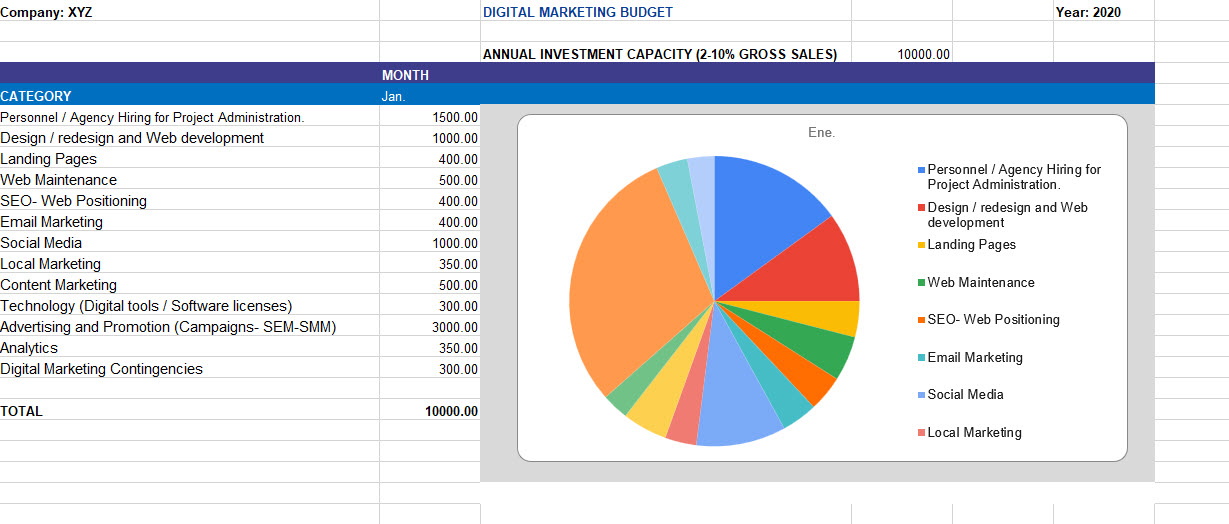
- Personnel / Agency Hiring for Project Administration.
- Design / redesign and Web development
- Landing pages
- Web maintenance
- SEO- Web Positioning
- Email Marketing
- Social media
- Local Marketing
- Content marketing (Inbound marketing)
- Technology (Digital tools / Software licenses)
- Advertising and Promotion (Campaigns- SEM-SMM)
- Analytics
- Digital Marketing Contingencies
- Miscellanious
We hope these tips, will serve as a modest solution or starting point to allocatee your Digital Marketing budget. Great budgeting!
Asignar el presupuesto que necesitamos para implementar nuestra estrategia de Marketing Digital se convierte en una pregunta recurrente entre aquellos que recién comienzan la carrera del Marketing Digital, aquellos que están buscando información para asomarse a este mundillo, e incluso para quienes ya han recorrido algún trecho y aun dudan de la efectividad de esta inversión. Ciertamente hay muchas variables que hay que barajar para determinar el costo o presupuesto de este tipo de Marketing.
Como primera pauta para definir este presupuesto ha de tenerse en cuenta en qué momento o en que posición se encuentra tu empresa en relación con tus objetivos y que esfuerzos necesitas hacer para alcanzarlos.
En otras palabras, tus esfuerzos de marketing estarán determinados antes que todo por tus objetivos y los ambientes de marketing, y estos últimos determinarán el presupuesto.
Ahora bien, el ecosistema de marketing digital de una empresa está definido por su sector o industria, y son categorizados de acuerdo con su dimensión, entre otros aspectos.
Dicho esto, podemos deducir que el presupuesto de Marketing Digital de una empresa difiere de otra, tanto como el presupuesto del hogar para cada familia del planeta.
Es sencillo entender, entonces, que los presupuestos de Marketing Digital de dos restaurantes de comida rápida nunca serán los mismos y mucho menos similares al de una empresa de aviación, una iglesia o una barbería.
No obstante, a pesar de la complejidad que implica dar respuesta a tan desafiante pregunta, en este post trataremos de ayudar a desmadejar los entretelares del presupuesto de Marketing Digital para ofrecerles una estructura general que sirva de guía inicial con independencia del momento en que se encuentre tu emprendimiento o empresa.
¿Qué factores se deben tener en cuenta para la planeación de un presupuesto de Marketing Digital?
El presupuesto de Marketing Digital se sustenta en un conjunto de estrategias online alineadas con los objetivos del negocio. El alcance de estas estrategias presupone la definición de los medios y recursos a utilizar para proporcionar la mejor experiencia a los usuarios, en tanto conseguimos la infraestructura más idónea para hacer más eficaz nuestro ecosistema digital. Pero, todo esto depende de los siguientes factores diferenciadores:
- Modelo de Negocio
- Objetivos de marketing
- Industria o sector
- Medio Ambiente Empresarial
Modelo de Negocio:
Existen diferentes modelos de negocios, comprendidos en tres grandes grupos; los modelos de negocios tradicionales, virtuales e híbridos, entre los que encontramos indistintamente los siguientes:
- Ventas Directas de Productos y servicios
- Franquicias
- eCommerce
- Dropshipping
- Marketing de afiliados
- Subscripciones/ Membresías
Cada modelo de negocio lleva una estructura y estrategia de Marketing Digital diferente, por lo que su presupuesto lógicamente también va a diferir.
Objetivos de Marketing:
Como dijimos anteriormente, la definición de tus objetivos va a estar relacionada con tu estado o posición actual, por tanto, una opción sencilla seria llevar a cabo una auditoria digital, que te pueda dar una visión objetiva de los medios y recursos que necesitarás para planear tu estrategia de marketing digital.
Ejemplo de algunos objetivos de marketing digital
- Mejorar la visibilidad en internet
- Aumentar el numero de visitantes al sitio web
- Hacer crecer la comunidad de Facebook
- Generar leads – prospectos interesados en nuestros servicios o productos
- Elevar las ventas mensuales
Estos objetivos carecen de todo sentido si no tienes como monitorearlos, por tanto, tienen que ser medibles, que es lo mismo que estar expresados en números.
Procure también que sus objetivos sean alcanzables de forma escalonada o acotados en el tiempo. Puede plantearse un monto anual y luego asignarlo a plazos más cortos para poder medir y corregir su efectividad. Esto le ayudara a no perder de vista su objetivo estratégico, e ir cumpliendo con sus planes a corto plazo o del día a día.
En este sentido nuestros objetivos quedarían algo así:
- Mejorar la visibilidad en internet en un 30 % con relación al mismo periodo del año anterior.
- Aumentar el número de visitantes al sitio web en un 200%
- Hacer crecer la comunidad de Facebook en 5000 seguidores
- Generar leads – prospectos interesados en mis servicios o productos- 1200 leads anuales
- Elevar las ventas anuales en un 150 %
Industria o sector:
Las estrategias de Marketing Digital varían en relación con las industrias o sectores. Los buyers personas o consumidores ideales de cada tipo de sector se encuentran en diferentes canales. Esto determina a que canales vamos a dirigir nuestros esfuerzos y la distribución o colocación de los fondos.
Medio Ambiente Empresarial:
El medio ambiente empresarial es todo lo que directa o indirectamente impacta el desempeño de una empresa. Para su mejor comprensión de ha dividido en micro-ambiente y macro-ambiente, definiendo como micro-ambiente el circulo mas cercano a la empresa y macro ambiente, el circulo exterior o a más alto nivel.
- Elementos del Micro-ambiente:
Recursos, clientes, proveedores, competencia, etc.
- Elementos del Macro-ambiente:
Fuerzas de la Naturaleza, Desarrollo Tecnológico, Políticas gubernamentales, Tendencias del Desarrollo socio cultural, entre otras.
La dinámica de todos estos elementos va a impactar directa e indirectamente a su empresa, de aquí a que la parte que corresponde a la implementación de su estrategia de Marketing digital debe ser considerada en el presupuesto.
Método alternativo de Calculo Presupuesto de Marketing Digital
Alternativamente, pudieras también hacer una Ingeniería Inversa basado en un porcentaje de ventas para modelar tu presupuesto de Marketing digital.
Si ya tienes un historial de Inversión en marketing digital, todo será más fácil porque podrás determinar tu costo de adquisición de nuevos clientes, que es el resultado de dividir la inversión anual que hayas hecho entre la cantidad de clientes conseguidos en un año. El costo de adquisición de nuevos clientes, lo multiplicas por la cantidad que te propones alcanzar para el próximo año y ya tendrías tu primera propuesta de borrador de presupuesto.
Pero, si no dispones de un historial y no tienes mucha experiencia en hacer estos cálculos, entonces una manera sencilla de concebir tu primer presupuesto de marketing digital sería a través de la ingeniería inversa. Aventúrate a estimar un % de tus ventas (preferiblemente entre el 2- 10% de tus ventas brutas) y distribúyelo por cada partida del presupuesto según la plantilla editable que te dejamos acá para que descargues gratis, donde aparecen las fórmulas ya establecidas de ratios preconcebidos. Solo tendrás que añadir la cantidad preliminar total de ventas que te has propuesto alcanzar, y te calculara los montos para cada partida.
Partidas del Marketing Digital a presupuestar.
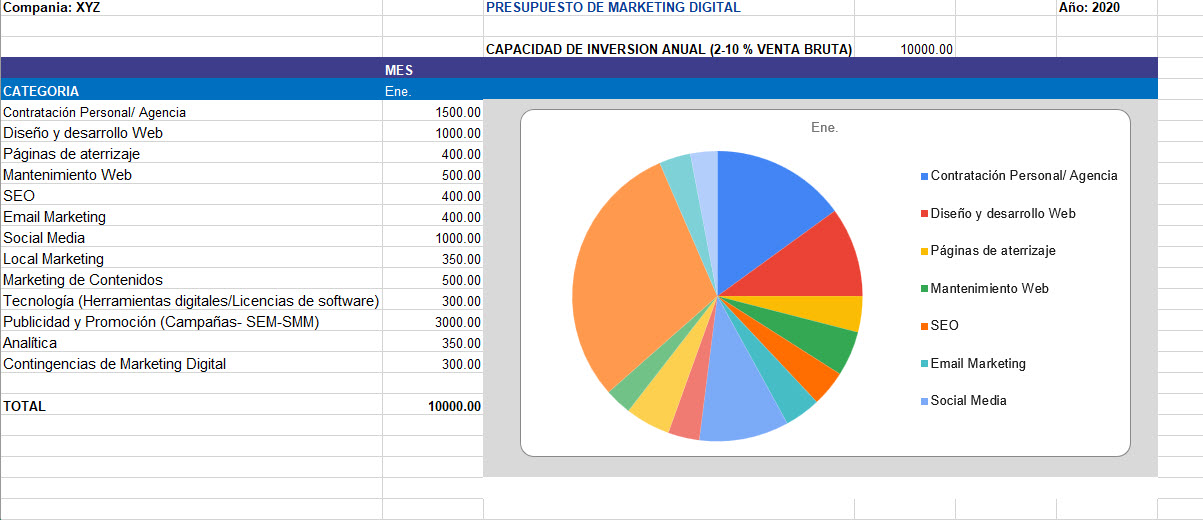
- Contratación Personal/ Agencia para la Administración del proyecto.
- Diseño/rediseño y desarrollo Web
- Páginas de aterrizaje
- Mantenimiento Web
- SEO- Posicionamiento Web
- Email Marketing
- Social Media
- Local Marketing
- Marketing de contenido (Inbound marketing)
- Tecnología (Herramientas digitales/Licencias de software)
- Publicidad y Promoción (Campañas- SEM-SMM)
- Analítica
- Contingencias de Marketing Digital
- Misceláneas
Esperamos que estos consejos, conjuntamente con la plantilla que te regalamos, te sirvan como una modesta solución o punto de partida para calcular tu presupuesto de Marketing Digital.
¡Excelente presupuesto!
slot
Slot game tại slot có biểu tượng Wild mở rộng, Scatter kích hoạt free spin và các mini-game phụ – mang lại nhiều lớp thưởng, tăng tính giải trí và khả năng thắng lớn. TONY03-25
188v game
Điểm cộng lớn của 188v game nằm ở tính minh bạch trong mọi hoạt động. Kết quả trò chơi được cập nhật công khai, tỷ lệ cược rõ ràng, giúp người chơi dễ dàng kiểm soát và đưa ra chiến lược phù hợp. TONY03-23O
xn88 - Chiến lược tối ưu SEO cho trang cược và sòng bạc trực tuyến
Bạn có thể xem live với hơn 200+ trận đấu siêu hấp dẫn như: xn88 – Chiến lược tối ưu SEO cho trang cược và sòng bạc trực tuyến Cyber Alliance Cup, Open Fire All Stars, Demacia Cup, LCK,… Chúng tôi cho phép người chơi so sánh tỷ lệ cược trước khi vào tiền đồng thời, xem nhanh kèo từ 3-4 ngày để vào ăn được bộn tiền khi chiến thắng. TONY03-17